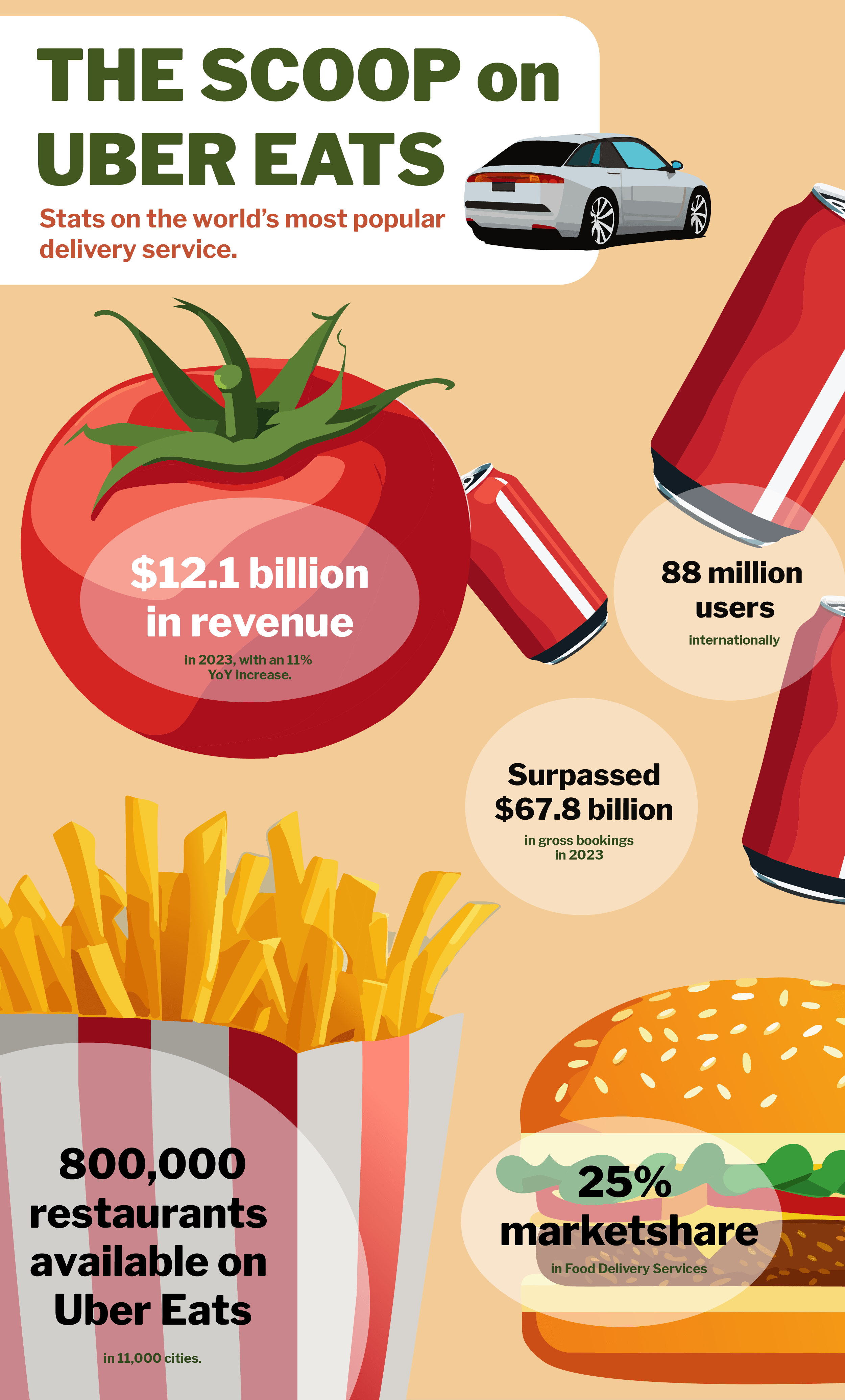
Launched in 2014, Uber Eats is a leading online food delivery service that connects you with a diverse range of local restaurants, making ordering food as easy as calling a ride. As a result, the service acts as an intermediary between users and restaurants where customers can browse, pay, and place orders all through the one app. Today, Uber Eats operates in over 6,000 cities in 45 countries, bringing convenient food delivery to doorsteps worldwide. Generating $12.1 billion in revenue in 2023, Uber Eats serves more than 80 million users and over 800,000 restaurants.
Since its emergence, on-demand delivery services have expanded, making it possible for consumers to place orders not only with local restaurants but other types of stores as well for the ultimate convenience. In fact, Uber Eats itself has expanded its platform beyond food delivery into grocery and retail delivery to offer users a wider range of products available for a quick delivery. For instance, Uber Eats partnered with Albertsons Companies to deliver groceries from various brands under its umbrella, such as Vons and Safeway, so that customers can order groceries online and have them delivered to their doorstep. Other stores that are part of the Uber Eats platform range from 7-Eleven to Drizly to Petco, offering users access not only to food items but more.
The Anatomy of the Food Delivery Industry: Key Players and Dynamics
The food delivery industry in general is part of the larger on-demand services market that has grown rapidly over the past few years. Just between 2017 and 2022, the industry’s revenue surged from $230 billion to $760 billion, reflecting a growth rate of approximately 230%. This includes meal delivery from restaurants, grocery delivery from markets, and more. The primary business models involved are platform-to-consumer (like Uber Eats and DoorDash) and restaurant-to-consumer (like Domino’s and other chains who work through their own delivery service platforms). Due to its rapid rise as well as the surge in the number of players involved, this industry has become highly competitive. The major competitors in the U.S. for Uber Eats include DoorDash, GrubHub, and previously Postmates before it was acquired by Uber. Uber Eats also has international competitors such as Deliveroo in the UK, Meituan Waimai in China, and Just Eat Takeaway throughout Europe.
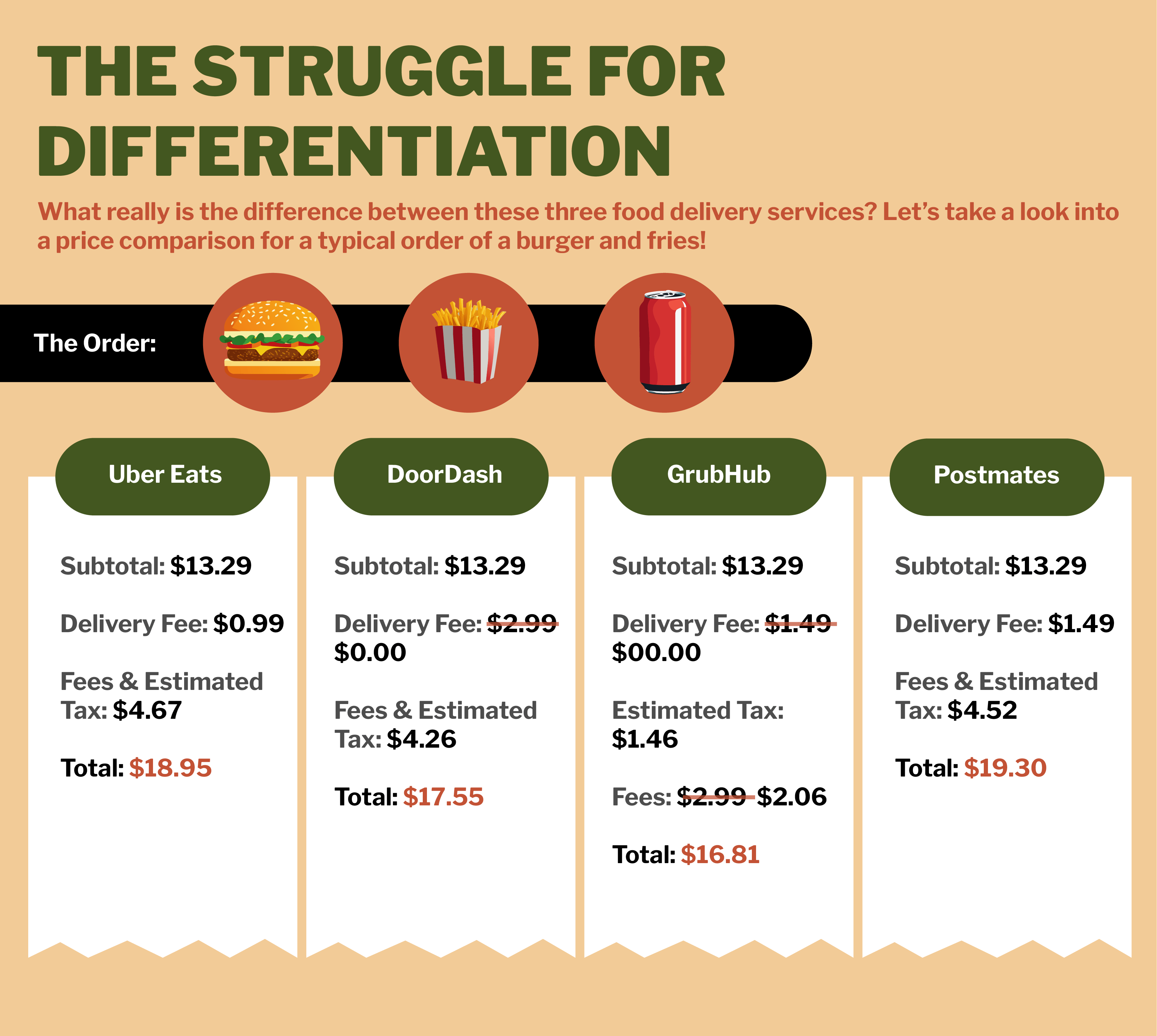
One key part of this industry is the participation of both restaurants and the drivers themselves. These are all people that both Uber Eats and their competitors have to pay, contributing to what Uber Eats eventually charges its users and impacting their unit economics. So, their participation also influences the general pricing strategy of these services.
With so many players involved, there are some key factors for competition within the industry to keep in mind. Pricing and promotions lie at the heart of this competition with constant active pricing action, competitive discounts, free delivery promotions and campaigns, as well as various loyalty programs set up to attract and retain customers. Each service offers their own subscription services as well to offer additional benefits to regular users.
These big players are also looking at technological advancements to gain a competitive edge. This entails investments in tech such as AI for route optimization, personalized recommendations, and efficient order management systems. They are also constantly exploring innovations such as autonomous delivery vehicles and drone delivery to make their processes more efficient.
These services also strive to secure exclusive partnerships with popular restaurant chains, promoting exclusive discounts only available to their own services. Furthermore, they compete with each other for collaborations with grocery stores and retailers to expand beyond food delivery and reach other customer segments.
The Pricing Strategy: Transitioning from Flat to Dynamic Pricing
Target Consumer Audience:
The overall target audience for Uber Eats includes a diverse range of customer segments who ultimately seek convenience, variety, and quick access to food.
- Geography: Urban dwellers, which include young professionals, students, and families, and families living in cities, typically use these services the most for quick meal options due to limited time for cooking. Uber Eats in particular is the leading service in large urban markets, such as Los Angeles and New York City.
- Profession: Uber Eats specifically targets busy professionals who have demanding work schedules and need time-saving meal solutions with fast and reliable delivery.
- Age: Another targeted customer segment includes younger millennials and Gen Z individuals because they are tech-savvy and value easy access through mobile apps, diverse food choices, and social sharing features, allowing them to order meals for social gatherings, study sessions, and casual dining.
- Health & Wellness: Uber Eats even caters to health-conscious consumers by promoting access to healthy and organic food options and providing nutritional information along with special dietary accommodations (e.g. gluten-free, vegan).
As a result, the target consumer audience for Uber Eats is vast, which is why it has been able to expand not only nationally but globally and reach new audiences.
Current Pricing Plan:
Uber Eats currently employs a multi-faceted dynamic pricing plan that includes various components in order to cater to different customer needs and preferences. All of their pricing includes variable delivery fees that dynamically change due to factors such as distance, demand, and the restaurant itself, ultimately ranging from $0.99 to $7.99. And, during peak times and/or in high-demand areas, Uber Eats will implement surge pricing and delivery fees will increase. Additionally, Uber Eats charges a service fee as a percentage of the order subtotal to help cover operational costs and platform maintenance. And, in some cases, Uber Eats may also charge a small order fee for orders that fall below a specific minimum amount.
In general, Uber Eats currently implements dynamic pricing to respond to shifting market demands. These real-time adjustments are based on algorithms that consider several variables, including demand, supply, and market conditions. Collecting vast amounts of data from various sources and using advanced analytics tools to process this data, Uber Eats can gain insights into demand patterns and price elasticity constantly that can help shape their own pricing on a daily basis. As a result, they use real-time data feeds and optimization techniques to maximize revenue, balancing supply and demand efficiently.
And, in November of 2021, Uber Eats introduced a subscription service called Uber One that is a monthly service priced at $9.99 per month with benefits including $0 delivery fee, member pricing, frequent discounts, and cancellation flexibility. So, access to the subscription service can eliminate many of the fees that are typically charged with your order.
For the restaurant-specific pricing, the restaurants themselves are fully in charge of setting their own prices on the Uber Eats platform, so this can differ from in-restaurant prices to account for the cost of delivery and their own service fees.
How Their Pricing Has Evolved
Uber Eats’ pricing strategy has materially changed over time. When it first launched, the platform often used a flat delivery fee model, charging a consistent fee regardless of distance or order size along with no additional service fee since the delivery fee covered the cost of the service. However, eventually they moved from flat pricing to variable delivery fees and service fees as the service expanded, accounting for factors such as the distance between the restaurant and customer, the time of day, and local demand. Thus, their pricing strategy became more flexible to account for a diverse variety of factors when an order is placed.
Then, Uber Eats began implementing surge pricing during peak times and in high-demand areas, increasing delivery fees further. They also worked to encourage larger orders by adding the “small order fees” for orders below a certain threshold. This indicated another shift from a variable pricing plan to dynamic pricing in order to account for demand differences and to capture revenue surges in demand. So, this involved using a lot of data and technology to adapt pricing in real time based on price driver factors.
They then added a subscription layer to their pricing by launching their subscription service Uber One, which could help build customer loyalty and provide savings opportunities for frequent users. Thus, this helped with more recurring revenue and retention.
Due to the highly competitive nature of the industry, Uber Eats constantly tweaks its pricing in response to competitor pricing, responding to the shifts in unit economics. They also constantly spend resources on discounting and promotions while expanding value-add services (e.g. groceries) to retain and attract customers who may be swayed and tempted to utilize other food delivery services instead.
Pricing Strategy Breakdown: Key Takeaways
Why is their pricing strategy effective?
- Dynamic Pricing: Uber Eats incorporates variable delivery fees and surge pricing so that they can adapt constantly to changing demand and supply conditions. These increased fees help them manage demand and incentivize drivers to be available. It also ensures that they can maintain profitability during periods of high demand by covering additional operational costs, so their dynamic pricing allows them greater adaptability than their initial flat delivery fee model.
- Transparency: Uber Eats provides customers with a clear breakdown of all of the fees included in the final cost before they place them in order to build trust and reduce the likelihood of negative surprises. As a result, this improves the overall customer experience as clear communication helps them understand what they are paying for, enhancing the perceived value.
- Introduction of a Subscription Model: Their Uber One subscription service offers tangible benefits like $0 delivery fees and reduced service fees for a monthly fee. This encourages frequent users to subscribe, increasing customer loyalty and recurring revenue. Additionally, subscribers feel they are getting a good deal, especially if they order frequently, making them less likely to switch to competitors. Furthermore, because this subscription service is a membership for both Uber and Uber Eats, it provides benefits beyond food delivery and accesses a larger customer base.
- Regional Adaptation: Adjusting pricing based on regional market conditions, local competition, and cost variations ensures that Uber Eats remains competitive and attractive in different areas. And, by tailoring pricing to local economic conditions and consumer behaviors, Uber Eats can effectively penetrate new markets and expand its customer base.
- Operational Efficiency: Service fees and small order fees help cover the operational costs of running the platform, ensuring sustainable operations. These small order fees also encourage customers to increase their order size, which can improve efficiency and profitability by reducing the number of small, less profitable orders.
What makes their pricing strategy different from others?
- More Pricing Flexibility: Uber Eats leverages surge pricing more prominently than some competitors. This approach adjusts delivery fees based on real-time demand, which helps manage peak times and incentivize more drivers to be available. And, their use of data allows them to implement dynamic pricing, which typically requires a lot of data computation and modeling. So, their flexibility from their dynamic delivery fees allows Uber Eats to optimize revenue and service availability.
- Comprehensive Subscription Service: Because their subscription membership is an all-in-one membership for both Uber and Uber Eats, users can become a member for savings and exclusive perks for both services. This increases the perceived value of the subscription compared to the subscription services of competitors and offers unique benefits connected to their ride-sharing platform.
- Willingness to Make Changes: Uber Eats has constantly worked to adjust their pricing and pricing strategy as needed, adding new fees as value is created and consumed by users. So, their approach in embracing changes has allowed them to focus on capturing their value in their prices and maximize profit.
- Extensive Promotions and Discounts: UberEats frequently offers targeted promotions, discounts on first orders, seasonal deals, and referral incentives. This proactive approach to promotions helps attract new users and retain existing ones. Also, this willingness to test pricing through promos and discounts showcases their willingness to adjust their pricing strategy and respond to developments in the industry as they arise.
- Seamless App Experience: The UberEats app is known for its user-friendly interface, live order tracking, and easy payment options. These features enhance the overall user experience and justify the pricing model. Also, due to the similar design and layout to the Uber app, there is continuity in their branding that creates a sense of familiarity for new users.
- Expanded Delivery Services: Beyond restaurant meals, UberEats has expanded into grocery delivery, alcohol delivery, and retail delivery. This diversification of services creates additional revenue streams and attracts a wider customer base.
How did they do it?
- Targeted Promotions and Discounts:
- First-Time User Discounts: UberEats attracted new users with significant discounts on their first orders, making it easy for potential customers to try the service at a lower cost.
- Seasonal and Special Promotions: The platform regularly offered seasonal promotions, holiday deals, and limited-time discounts to encourage more frequent ordering and boost customer retention.
- Referral Programs: UberEats incentivized existing users to refer friends by offering discounts or credits to both the referrer and the new user, effectively expanding its customer base through word-of-mouth.
- Fee Breakdown Explanation: Detailed explanations of the various fees were provided in the app and on the website, helping customers understand the value they were receiving for the price paid. This transparency helped build trust and reduce potential friction points that typically come with price increases.
- Subscription Service Marketing: To entice users to try Uber One, the company offered free trials or discounted introductory rates, allowing customers to experience the benefits before committing to a monthly fee.
- Strategic Partnerships and Exclusive Deals: UberEats partnered with popular restaurants and chains to offer exclusive deals and promotions, which were heavily marketed through various channels. These partnerships not only provided value to customers but also differentiated UberEats from competitors by working with prominent chains such as McDonald’s, Starbucks, Chipotle, Sweetgreen, and more. And, by expanding into grocery and retail delivery, UberEats marketed itself as a comprehensive delivery service, offering more than just restaurant meals. This was communicated through targeted ads and promotional campaigns.
- Leveraging Technology and Data: Using data analytics, UberEats personalized its marketing efforts by recommending promotions and deals based on user behavior and preferences. This increased the relevance and effectiveness of their marketing campaigns. They also used the platform’s in-app notification system to inform users about ongoing promotions, subscription benefits, and new features, ensuring that customers were always aware of opportunities to save money.
- Cross-Promotion with Uber: UberEats leveraged its connection with Uber’s ride-sharing service to cross-promote deals and subscriptions, offering bundled discounts and promotions to users of both services. This strategy helped to tap into Uber’s existing user base.
Did you know?
We shared this article with our email newsletter community first. If you want to get access to our articles and insights before anyone else, you can sign up here (plus, it’s free!).
Found this article helpful?
Sharing is caring. 
Share this on social – super easy 1-click share buttons below  – or send this article to a colleague or friend who can learn something new to empower their company or hustle.